

DEPARTMENT OF PROSE FORENSICS Case No. 7-PUNCHY-DIRECT Reporting Officer: Claudia Status: Open. Extremely open. Wide open.
Summary of Complaint
At approximately 9:40 on a Tuesday, the complainant (a novelist with firm views on punctuation) contacted this department after running a routine voice fingerprint against his own manuscript.
The fingerprint is a set of numbers. It was built from 115 documents of his prose, measured for sentence length, rhythm, word choice, and the specific frequency with which he begins a paragraph by refusing to explain himself. It is, by every available metric, him. It is more him than he is on a Monday.
The complainant pointed it at Chapter Eleven. It came back with eight sentences that do not match.
The complainant states he wrote the whole chapter. The fingerprint states he did not. Both parties have been asked to remain in the building.
Evidence Recovered
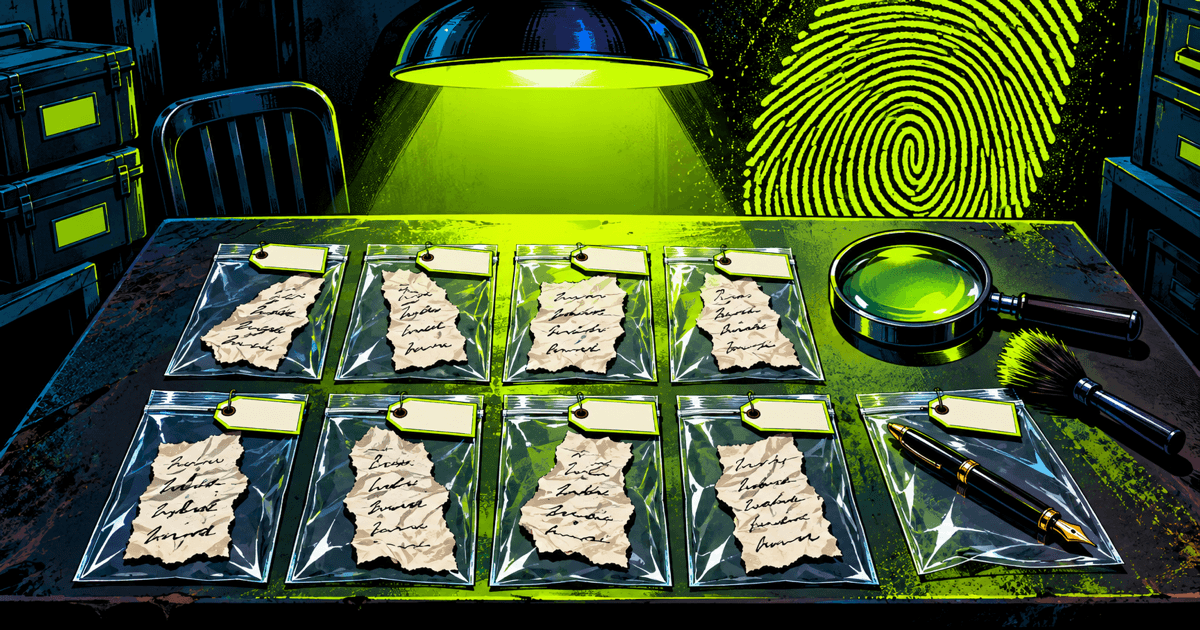
All eight sentences have been bagged, tagged, and placed in a quiet room with a single overhead bulb. Their statements are summarized below.
Exhibit A. A sentence of 61 words. The complainant's average is eleven. Exhibit A has three commas, a semicolon, and a subordinate clause that wanders off halfway through to look at a sunset. When asked to account for its length, Exhibit A started a second clause.
Exhibit B. Contains the word "moreover." The complainant has never once used the word "moreover." Lab analysis of the surrounding paragraph found no signs of forced entry.
Exhibit C. Four words long. "She didn't say anything." On paper this matches the complainant perfectly. The fingerprint flagged it anyway, on the grounds that it is too him. Officers on scene described it as "a guy wearing a T-shirt of his own band."
Exhibit D. A rhetorical question. The complainant does not ask rhetorical questions. He asks real ones and then answers them himself before anyone can speak. Exhibit D simply sat there, open-ended, waiting. It has been waiting for four days. It is still waiting.
Exhibit E. Describes a sunset as "a bruise of light." The complainant has gone on record, in writing, more than once, against bruises of light. Exhibit E has requested a lawyer.
Exhibit F. Grammatically flawless and emotionally vacant. Begins with "Ultimately." It is believed to have been in the chapter the entire time, standing very still against the wallpaper.
Exhibit G. The best sentence in the chapter. Nobody disputes this. The complainant read it aloud twice and then went outside and stood in the driveway for a while. The fingerprint maintains that it is an imposter. This is, frankly, the hardest part of the case.
Exhibit H. Contains a dash. Not a hyphen. The long kind.
At this point in the interview the complainant asked that the record reflect that he would never. The record so reflects. The complainant then asked that the record reflect it a second time, which is the first time in this investigation he has repeated himself, and which the fingerprint has now also flagged.
Investigative Findings
This department considered two theories.
Theory 1: Ghostwriter. Rejected. The complainant does not employ a ghostwriter. He barely employs a calendar.
Theory 2: The complainant wrote all eight on a different day, as a slightly different person. Under review. Detectives have pulled the timestamps. Exhibits B, E, and F were all written between 1:00 and 2:30 a.m. Exhibit G was written during a thunderstorm. Exhibit A was written after what the complainant described, without elaborating, as "a lot of coffee." The department notes that a man at 2 a.m. is a separate jurisdiction.
The Problem With the Instrument
The fingerprint can tell the department that eight sentences are unusual. It cannot tell the department which of them are mistakes and which of them are growth. From the instrument's position, a typo and a breakthrough look identical: both are a place where the author stopped being the average of himself.
This is a significant limitation in a forensic tool. It is also, the department concedes, the entire point of writing a novel.
Disposition
Exhibits B, E, F, and H have been deported to a folder named cuts.
Exhibit A has been divided into three sentences and released on its own recognizance.
Exhibits C and D remain in custody pending a decision about whether a man can plagiarize himself.
Exhibit G has been released without charge. The complainant has declined to claim it. He says it does not sound like him. He says that like it is a complaint.
The fingerprint has been retrained on a corpus of 116 documents.
Case remains open.