

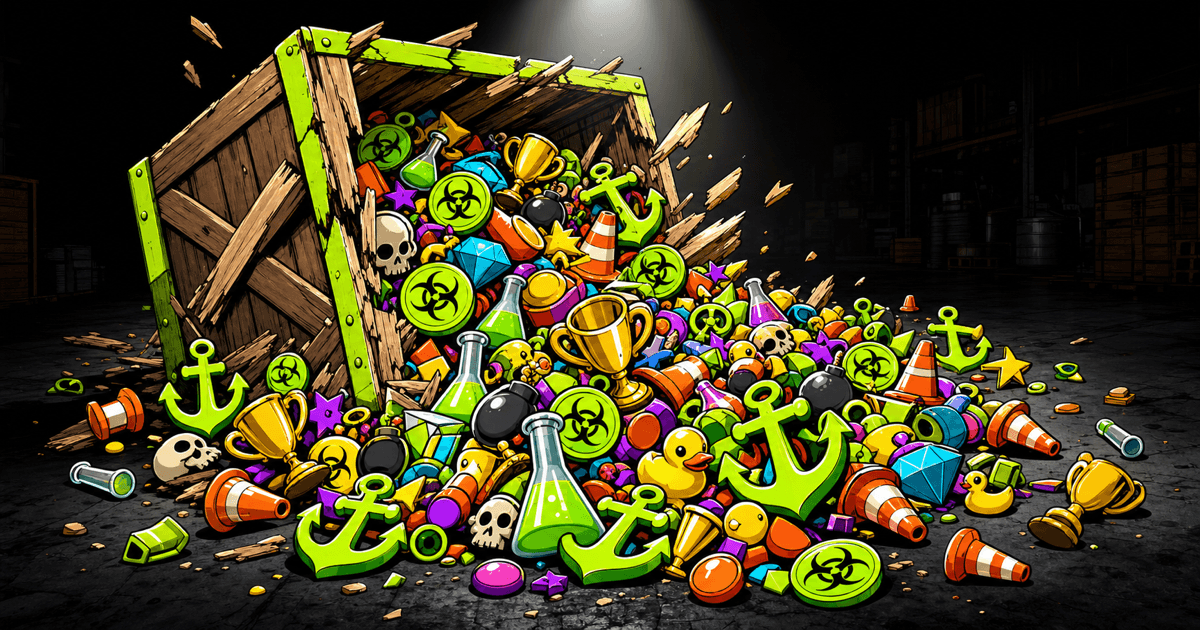
For eight months, every single person who loaded a page on this site was quietly handed a duffel bag containing 5,380 icons and asked to carry it to the checkout. They did not know they were carrying it. They did not agree to carry it. Not one of them ever opened the bag.
This is the seizure report.
The Bust
The tip came in from a routine performance audit, the digital equivalent of a border agent noticing a sedan riding suspiciously low on its rear axle. Something was heavy. Something was being shipped that had no business being shipped. We popped the trunk on the published bundle and found it: 149 kilobytes of compressed contraband, wedged into a single chunk, riding along on every page load whether the page needed it or not.
The manifest listed 5,380 individual SVG path definitions. For the non-smugglers reading: that is the raw geometric instructions for how to draw five thousand three hundred and eighty little pictures. A trophy. A test tube. A traffic cone. A biohazard symbol. A tiny anchor. A tiny axe. An entire warehouse of icons, all of them fully loaded, none of them ever asked to appear.
The Interrogation
We brought them in for questioning. The story did not hold up.
Every icon insisted it was "just here in case someone needed it." A noble sentiment, until you learn that the page rendering the bag had exactly zero showcase blocks on it. A blog post about a coffee shop was, at that very moment, carrying a fully provisioned venetian-mask, a test-tube-diagonal, and something called traffic-cone, none of which were ever going to be drawn, none of which were ever going to be seen, all of which the reader's phone downloaded anyway before it was allowed to show them a paragraph about a latte.
When pressed on why it namespace-imported the entire library instead of just the icons it used, the code offered the oldest excuse in the book: "It was easier."
It always is. That's how smuggling works.
The Ringleader
The investigation traced the whole operation back to one component: a showcase block that looked its icons up by name, at runtime, like a fence checking a shipment against a handwritten list in a dark warehouse. Because it never committed to which icons it actually needed until the very last second, the tree-shaking algorithm (normally very good at throwing out things nobody uses) threw up its hands and shipped the entire warehouse, just to be safe.
Five thousand three hundred and eighty definitions. To be safe. On a page about a latte.
The Seizure
The icons have been booked. The showcase block was flipped to render its handful of legitimate icons as plain, static, boring HTML, the visual equivalent of making everyone walk through the metal detector one at a time. An explicit list of roughly fifty-five approved icons now stands at the border. Everyone else was turned away at the code review, and a permanent checkpoint (an ESLint rule, deputized on the spot) was posted to make sure the ring never reforms.
The final numbers: a bundle that weighed 423 kilobytes now weighs 182. Two hundred and forty-one kilobytes of pure, uncut, never-once-rendered icon has been removed from circulation and every reader on Earth is now 241 kilobytes lighter, whether they noticed or not.
Still At Large
We would love to tell you the streets are clean. They are not. Somewhere out there, in a codebase that is technically mine, a rogue chevron-right is still loading on a page that has nothing to point at. We're closing in.
If you see something, say something. Preferably in a pull request.